Rising Voices is a project to extend the reach of citizen media globally - Details Here


Archive for the ‘Uncategorized’ Category

Connectivity and Posting Frequency

Lunes, Noviembre 3rd, 2008

Since the beginning of the Voces Bolivianas projects, it can be roughly estimated that 20% of the trained participants continue to write in their blogs after the classes end. Some might argue that this number is way too low for the resources invested into the project, while most would probably agree that the number is higher than the average for the general public, for those who open blogs and continue to write. It is, however, something that we are continuing to address.

Without a doubt, one of the main reasons for the decline in activity is connectivity issues. Based on demographic polling, only 1-2% of participants have internet at home. For regular bloggers, they can attest that this steady access really encourages regular posting. Recently, we have seen how this has helped with the production of content with the blog of Ruben Hilari.

Ruben, originally form El Alto, is a languages study at the public university, and he also ran a language school for students wanting to learn English and Aymara. Recently, Ruben received the opportunity to study and teach at a school in upstate New York, where he has been for the past few months. We have also seen the frequency of his updates increased as a direct result of having internet access at school and in his room.

For example, he has written about the holiday of Halloween [es], other special days at the school and about his first two weeks in the United States (translation):

-Of course, before starting the trip I was nervous and stressed.
-I was excited for my first flight and I could see the “Illimani” (mountain overlooking La Paz) up close.
-For the first time, I saw a giant airport where the planes were side by side like taxis
-Another things that impressed me was in Miami, the majority of people spoke English or Spanish.
-The first thing that Anne (host) told me was to put on my seatbelt or she would be fined. It appears that there is no cars without seatbelts.
-That night I rested in an American house, where I felt that everything was automated.
-Another thing that impressed me was that I didn’t understand many of the things that they said to me in English, even though I had studied and I had taught English. It is nice for one’s head to hurt trying to understand the English that they speak after having studied and taught English in Bolivia.
-It is very common to see supermarkets and nothing in streets like in La Paz.
-Peter, the school’s principal, told me that they don’t want to the school to be homogeneous, rather heterogenous.

The blog has helped him communicate to his friends and family back in El Alto about his new experiences in the new land.

One Year Anniversary

Jueves, Octubre 2nd, 2008

Last month, Voces Bolivianas published their annual evaluation in which the challenges and successes . Now, one of our most celebrated blogger, Cristina Quisbert of Bolivia Indigena [es] commemorates this anniversary:

It is well known that there are not as many bloggers than there are in other countries. The majority of bloggers are concentrated in La Paz and Santa Cruz and these are primarily in the capital cities. However, when Voces Bolivianas arrived to El Alto, I consider that they planted an important seed so that young people and adults can begin to use the blog as an instrument to communicate realities, knowledge and feelings.

A Look Back at the Past 11 Months

Lunes, Septiembre 1st, 2008

Blogger Virginio Sandy arrived in La Paz for the 2nd annual national Bolivian bloggers conference. Mr. Sandy is an indigenous “authority” of his ayllu, who is selected on a rotating basis to be a leader of his community. During his presentation on the panel of Digital Literacy, he explained how his community lacks electricity, much less internet. However, he conveyed the importance of maintaining his blog, as it has become a two-way window to the rest of the world. At the conference, he joined 10 of his fellow Voces Bolivianas participants, who came from El Alto, rural communities on the Altiplano, and Santa Cruz. These participants made up a large percentage of those in attendance, and achieved that the gathering was much more representative in nature.

The new bloggers, members of the Voces Bolivianas team, and bloggers at large all interacted in person, and regardless of ethnicity, geography or social class and in essence, what the project is all about. Success can be measured in the number of blogs created, as well as the number of posts written, but narratives such as seeing real relationships built has shown that Voces Bolivianas has accomplished some of its mission.

With the Public Conference held on August 29, which drew 83 attendees and the Barcamp, where 16 bloggers showcased their projects and ideas, Voces Bolivianas completed its first year. What had started in September 2007 as a one-time workshop for 23 residents of El Alto expanded due to necessity, interest, and the commitment of all those who have taken part. Even though there is much to improve upon, there is definite interest in continuing through 2009. Some of the highlights of 2007-2008 include:

Accomplishments

* The completion of three multi-month projects - El Alto I, El Alto II, and Santa Cruz I
* Bolivian Voices Day on April 19 with the help of many national bloggers in 9 sites in 6 cities.
* Travel scholarships offered to attend the 1st and 2nd Bloggers Conferences
* Additional workshops in Achacahi, Trinidad and Sucre (workshops have reached 6 of the 9 country’s department)
* Translation of content to English and the indigenous language of Aymara
* Presentations at We Media in Miami and the Global Voices Summit in Budapest
* Participants acted as guide for foreign journalists
Laptop Cover Fundraiser
* Public Conference and Barcamp/Fair in El Alto
* Media Coverage in national newspapers, La Nación of Argentina, BBC World, and the Organization for American States Magazine

Even though there is much to celebrate, the team knows that there is much to improve upon and much yet to be accomplished. Over an organizational team luncheon, there were discussions about the direction, especially for the rest of the calendar year. Much of this will be a prelude to the Voces Bolivianas summit, which will be held in December in the city of Cochabamba, where much of the future of Voces Bolivianas will be decided involving many of the stakeholders that have participated in this process.

Strengths

Much of the success of the project is due to the commitment and passion of team members who believe in the mission of spreading the use of citizen media to underrepresented groups. Even though the initial grant money from Rising Voices completed in March, team members continued with tasks and iniatives in their free time. In addition, many more bloggers and supporters of the project have joined the cause and have volunteered their time, for example, on Bolivian Voices Day, where 19 bloggers took part in the implementing the training sessions. This support nationally from bloggers is essential, and includes many reading the new blogs. Interest from potential students, organizations and institutions is high and there is a waiting list to take part in future actitvities.

Weaknesses

The Bolivian blog community Blogs Bolivia [es] noted that a small number of original workshop attendees have continued writing in their blogs. One can point to the lack of access, lack of time, and lack of habit of writing. This carries over to the workshops,where Voces Bolivianas must rely on public, costly and unreliable internet cafes for workshops. Another weakness is an informing, yet evolving teaching curriculum, which is not consistent. Students have asked for manuals, yet a definitive and all-encompassing manual has yet to be developed. Finally, even though there is a lot of commitment by the team, each has their own jobs, other projects and other responsabilities that often have to come before the tasks of Voces Bolivianas. A lack of legal standing is an obstacle to receiving larger amounts of funding.

Opportunities

Due to the high interest, the organization can be choose more carefully with which groups and organizations to work. High visibility nationally also attracts potential trainers and the ability to expand to new regions of the country. Due to the multi-talented potential of the team, there is an opportunity to branch out to other areas, such as citizen journalism, web entrepreneurship, and other media projects. The interest and support internationally has yet to be tapped to its full potential.

Threats

An informal adminstrative structure can leave the organization open to skepticism by outside observers, which would overshadow the work of Voces Bolivianas. In addition, there is also the possibility of trying to expand for the sake of expanding and spreading the team too thin. Having a part-time coordinating team can often leave tasks unfinished due to lack of time.

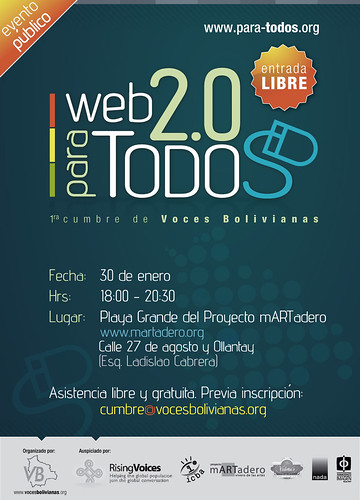
Ready for Busy Week in El Alto, Bolivia: Conference and Barcamp

Domingo, Agosto 24th, 2008

The 2nd annual bloggers conference called Bloguivianos [es] will take place in El Alto and La Paz on August 29 and 30. The organizing committee had asked Voces Bolivianas to be in charge of the festivities in the city of El Alto. After discussion, Voces Bolivianas will put on a public conference for members of the general public in El Alto, featuring talks by prominent national bloggers regarding blogs, fotos, videos, podcasts and social networking sites.

Following the public conference, the first ever Barcamp and Fair will take place in the afternoon of the 29th. An open call for bloggers [es] to come and present their blogs and web projects was announced on the Voces Bolivianas and Bloguivianos websites.

barcamp bolivai

Once again, Voces Bolivianas is offering travel scholarships [es] to bloggers from underrepresented groups and regions. It will be a busy week in El Alto, but many of the participants from the first two El Alto projects have offered to help with the day’s activities.

An Outlet for Expression

Miércoles, Junio 4th, 2008

It has been more than a month since “Bolivian Voices Day” took place all across the country. Some have mentioned that a one day workshop was not nearly enough and point to the fact that many of the new bloggers for one reason or another have not continued to blog. However, I am still under the notion that we reached 86 new potential bloggers, who at least now know that this option exists. Perhaps in other circumstances, such as better internet access in their neighborhood or more time to write, then they can pick up where they left off.

One participant from the April 19 event, Nancy Condori, participated in the city of El Alto. Her blog called El Chairo [es] had been updated only once since the first workshop. However, reviewing the RSS feeds, I came across a very authentic and heartfelt entry. Perhaps Nancy did not write the entry for any particular audience in mind, but thanks to the blog workshop, she knows that she has an outlet to write about her feelings and begin to heal. Here is a translation of her blog entry:

Did you know that having a baby in your home is the most beautiful thing?

Well, I had a baby in my home, but due to circumstances, she wen to heaven and is no longer with me. I feel sad because of the little one’s absence, maybe for some it might seem absurd to cry for the loss of someone that was at my side for such a little time, but she meant a lot to me, even though some of my friends said that it was for the best so that she wouldn’t have to suffer. Who know? All I know is that wherever she is that she will take care of me. I haven’t stopped thinking about the beautiful baby called LINMEY, who went to heaven like a small angel. Only God knows why she left my side. I still weep for her departure, even though her parents abandoned her. For me, she was like my daughter, and writing these lines still move my heart and I can’t keep from crying because of her absence.

A piece of advice for single fathers, single mothers, and parents: love your children because it the most beautiful gift that God and life can give.

New Logos

Jueves, Abril 3rd, 2008

Here is the brand new logo for Voces Bolivianas

logo

and the logo to be used for “Bolivian Voices Day on April 19″

19deabril

Bolivian Voices Day - April 19

Lunes, Marzo 31st, 2008

Please note the new date of April 19,

The need to reach more Bolivians in underrepresented groups created the need to launch the campaign “Bolivian Voices in Your Community” in order to ask for the help of local bloggers to bring a Bolivian Voices 2-month project to they communities and teach the use of web 2.0 tools (blogs, digital photography, audio and video). The response was overwhelming and moving and included proposals from more than 24 people and institutions from 6 of the 9 departments. In order to reach more people, Bolivian Voices decided to change the workplan in order to accomodate more teaching sites and reach a wider audience.

Bolivian Voices would like to announce that April 19 will be “Bolivian Voices Day” where in approximately 10 sites across the country, a workshop on the creation of blogs will be helpd. With the help of local bloggers, approximately 120 participants will receive instruction on how to open, create and maintain their own personal blog and how to be a part of the Bolivian Voices community, as well as the local and national blogosphere.

The confirmed sites include the continuation of the sites in El Alto and Santa Cruz, but also the launching of new sites in La Paz, Oruro and Cochabamba. More sites will be confirmed this week. More details and a list of sites and collaborators will be released this week.

“Bolivian Voices Day” will also be an opportunity to talk about some of the topics of why there are so many voices without representation in the Bolivian blogosphere and what we all can do so that these internet tools can help bring people together and look for ways to overcome these obstacles such as lack of access and lack of knowledge from the population.

Many thanks to all of those who are supporting this blogger citizen’s movement, including all of the participants of the projects in El Alto I, El Alto II and Santa Cruz I, the coordinators, the volunteers, special invited guests, media, institutions, organizations, national and international bloggers, Rising Voices network of projects and Rising Voices for the funding that made the first three projects possible.

More details in the days to come….

Delayed Reaction

Sábado, Marzo 29th, 2008

One night on Instant Messenger, I received a message from one of our Coordinators, Hugo Miranda, who said, “guess who is back?” He proceeded to pass me the link of one of the participants from the first project El Alto I. Ruben Lipe, who opened his blog Rubensistem [es] only attended two of the four sessions and was unable to participate in any other activities. Perhaps he became bored with the idea of a blog or maybe he had better things to do.

However, nearly six months after his first post, Ruben returned explaining his absence. Ruben works in the field of education and works in a rural province in the Bolivian Altiplano, where the internet connection is even less available than in some parts of El Alto. He then proceeded to write about some of the experiences working in the rural parts of Bolivia, as well as the fact that the local population stage football tournaments during Easter week and even hire professional football players from La Paz to act as ringers.

The most satisfying part of discovering the return of Ruben is that the lessons taught about how to write and publish on his blog were not lost nearly half a year later. Ruben obviously has a lot of interesting stories from his days spent in the provinces, and remembered that his blog is an excellent resource and place to share those stories.

Closing Celebrations Scheduled

Domingo, Marzo 16th, 2008

An important part of the workshops is the closing program, where the participants get the opportunity to invite friends and family to hear about their experiences with Voces Bolivianas. On Tuesday, March 18 the closing program will be held in El Alto for the participants of the 2nd round of workshops. Later in the month, the closing program for the Santa Cruz project will also take place.

In addition to sharing a meal with fellow participants, friends and family and other local bloggers, the Voces Bolivianas participants each say a few words and show off their blogs on the overhead projector.

However, there will also be a special announcement made at the closing ceremony on March 18 in regards to the next plans for Voces Bolivianas.

What Constitutes Success?

Viernes, Febrero 8th, 2008

What makes a participatory media project successful? Reviewing the original Rising Voices application, we wrote:

How will you measure and evaluate your project’s impact – on your main participants? other contributors? on the larger community? How many participants do you expect to be involved in your project? How will you seek and sustain their involvement? (200 words)

According to unofficial estimates the city of El Alto currently has 10 blogs, many of which are maintained by the same author. The main evaluative measure will be the number of blogs and blog entries that are created and maintained over the course of the two-month project. Follow-up after the project ends will be essential to ensure that the blogs continue, which will be encouraged through additional opportunities for internet access. For selected participants, the digital cameras and voice recorders will be awarded, which will be an incentive to produce high-quality work and making it easier to create content in the future.

Some of the participants will be encouraged to be part of future outreach programs and help continue to teach others about these tools.

Another evaluative measure will be participants’ attitudes towards these new technologies. A pre and post-test will be provided to measure the participants’ attitudes towards the ability to express themselves, as well as their comfort using internet tools.

This has been a topic of discussion internally, as well as some observers and supporters of the project. The Bolivian blog community site Blogs Bolivia took a look at the 23 new participants blogs and indicated which ones were still writing 3 months after the final workshop took place. They found that 25% of the blogs were still writing in the blog and observes:

Sadly we find that the majority of the (new bloggers) have stopped publishing between the months of October and November. This means that even though they learned the new technology, there are still reasons related to costs, interest, or habit, which caused them to stop writing. Or maybe the teaching methods have not found the right group.

The article goes onto say that when looking at it from a more optimistic viewpoint, one could say that there are six more blogs in El Alto that there were before. Since this is the first project of its kind in Bolivia, would some be happy with these results or would a perfectionist like me feel like we didn’t do enough. I offered up these possible remedies for this number, with the hope that the numbers will increase after the second project in El Alto:

1) During the registration, we should find those with more of a commitment. There will always be people that love to blog and others that will say, ‘this is not for me.’ Maybe we can charge a small registration fee and if they complete all of the workshops, then they will be refunded in full. (This is a little complicated, because we want to ensure everything remains without cost.)

2.) More support during the week. If they are not writing, then there should be calls or text messages to see if they need help or additional personal help. The lines of communication have always been open for those with questions, but maybe this should be increased.

Is it simply a question of raw numbers, i.e. an increase in the number of sustainable blogs? We also sought to measure attitudes and acquisition of knowledge. A pre and post test was given to the participants to ask them about their knowledge regarding the use and familiarity of blogs. For the pilot project, on a scale of 1-5, we found that the participants felt that they increased their knowledge in the use of blogs from 1.5 to 2.6. In addition, we also asked them about their knowledge of the advantages of having a blog, i.e. their utility. This also increased from 3.0 to 4.1. This may not be entirely scientific, but it does show that these workshops do help in some way in regards to the participants’ knowledge and attitudes towards the use of blogs.

Nevertheless, it is still a learning process in seeing what works and what should be scrapped altogether. Some things cannot be measured, but can simply be observed, such as when Bolivianas, who had no previous knowledge of these new tools, become excited to write and share their stories. It can also been seen in young people, who continue to share their traditions handed down from generation to generation, as well as write in their native language of Aymara.

It is still a work in progress, and hopefully the percentage of new bloggers that continue will begin to rise more and more.